
Ebooks
Scaling a startup
Creator

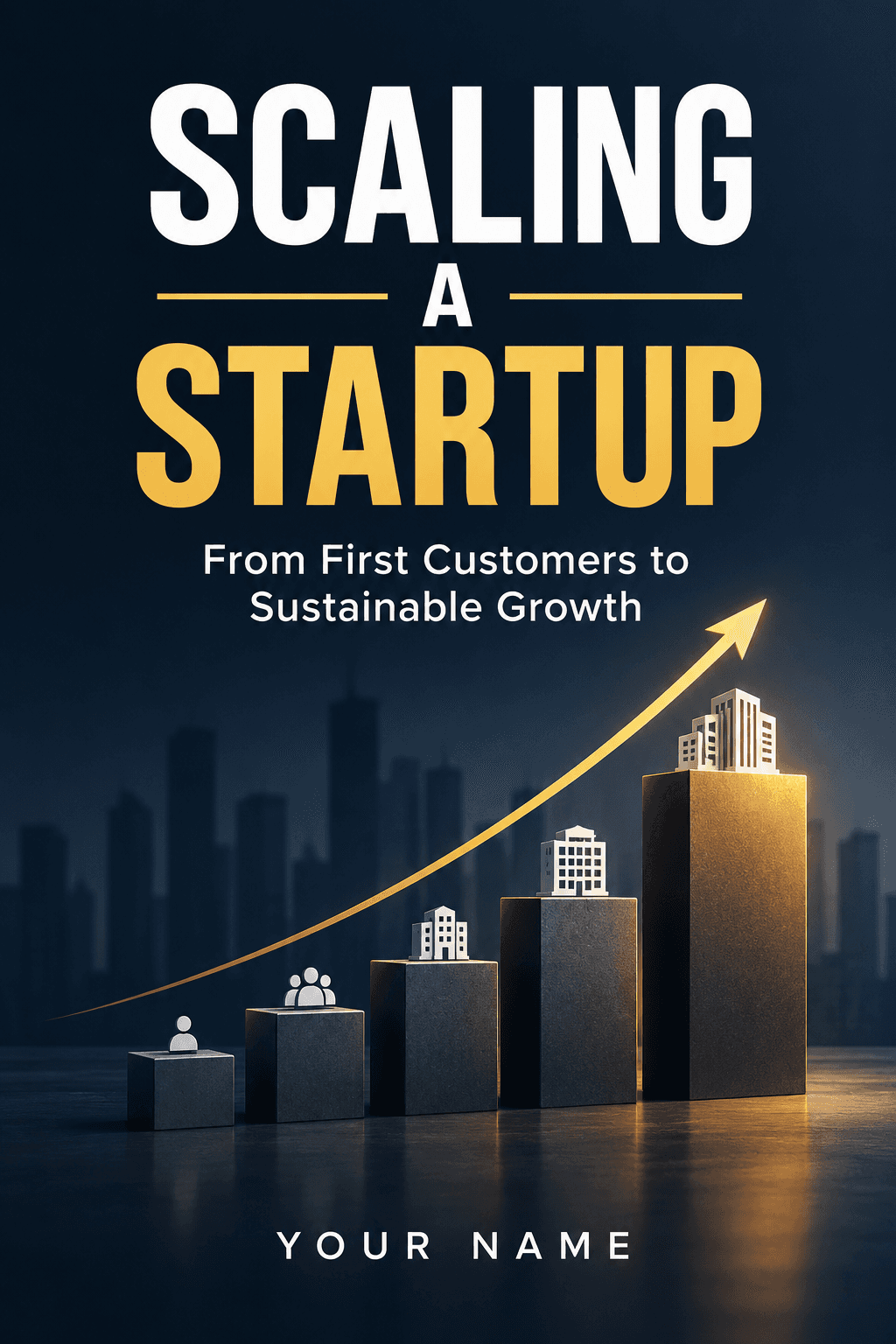
Scaling a Startup
The Practical Playbook for Growing from Your First Customers to a Scalable Business
By [MR. FELIX ]
Disclaimer
This book is for educational and informational purposes only. It does not constitute legal, financial, investment, tax, or professional business advice. Every startup is different, and strategies should be adapted to the specific circumstances of the business, market, customers, and jurisdiction.
Table of Contents
- From Startup to Scalable Business
- Finding Product-Market Fit
- Building a Repeatable Sales System
- Customer Acquisition on a Budget
- Pricing for Growth
- Building Systems and Processes
- Hiring Your First Key Employees
- Using AI to Scale Operations
- Managing Cash Flow While Growing
- Metrics Every Founder Should Track
- Scaling Marketing and Brand Awareness
- Expanding Into New Markets
- Common Scaling Mistakes
- Building a Leadership Team
- Your 90-Day Scaling Plan
- Conclusion
Introduction
Starting a business is difficult.
Scaling one is different.
In the early stages of a startup, the founder often does almost everything. You find customers, answer emails, make sales, solve problems, manage finances, create marketing content, handle operations, and sometimes even deliver the product yourself.
That approach can work when you have ten customers.
It becomes dangerous when you have one hundred.
And it can become impossible when you have one thousand.
Scaling means building a business that can handle substantially more customers, revenue, employees, and complexity without increasing costs and problems at the same rate.
The objective isn't simply to become bigger.
The objective is to become better, more efficient, more predictable, and more profitable while growing.
A company that doubles its revenue but also doubles its problems hasn't necessarily scaled.
A scalable startup develops systems that allow growth without requiring the founder to personally control every decision.
This book provides a practical framework for doing exactly that.
You will learn how to:
- Identify whether your business is ready to scale
- Find and strengthen product-market fit
- Build repeatable sales processes
- Acquire customers efficiently
- Price products for sustainable growth
- Create systems and processes
- Hire the right people
- Use AI to increase productivity
- Manage cash flow
- Track the metrics that matter
- Expand marketing
- Enter new markets
- Avoid common scaling mistakes
- Build a leadership team
- Execute a 90-day growth plan
The goal is simple:
Build a business that can grow without breaking.
Chapter 1: From Startup to Scalable Business
What Does Scaling Actually Mean?
Growth and scaling are often used as if they mean the same thing.
They don't.
Growth usually means increasing revenue, customers, employees, or market share.
Scaling means increasing output and revenue faster than your costs and operational complexity increase.
Imagine two businesses.
Business A increases its monthly revenue from $20,000 to $40,000 but needs twice as many employees and twice as much operational effort.
Business B increases revenue from $20,000 to $40,000 while increasing its operating costs only modestly.
Business B is demonstrating stronger scalability.
The difference usually comes from systems, technology, processes, distribution, and organizational design.
The Four Stages of a Startup
A useful way to think about startup development is:
Stage 1: Problem discovery
You identify a meaningful customer problem.
Stage 2: Validation
You determine whether customers actually care enough to pay for a solution.
Stage 3: Product-market fit
You develop a product that solves the problem consistently and has evidence of customer demand.
Stage 4: Scale
You build repeatable systems for acquiring customers, delivering value, hiring people, and generating sustainable revenue.
Many founders try to jump directly from Stage 1 to Stage 4.
That creates problems.
If customers don't genuinely want your product, scaling marketing only helps you lose money faster.
The Founder Bottleneck
One of the biggest obstacles to scaling is the founder.
This sounds strange because founders create startups.
But founders can eventually become the limiting factor.
Ask yourself:
- Does every major decision require me?
- Do customers always need to speak with me?
- Do employees constantly ask me what to do?
- Am I personally responsible for most sales?
- Would the business stop functioning if I disappeared for two weeks?
If the answer is yes, you haven't built a scalable organization yet.
You've built a business around yourself.
The goal is to gradually replace personal involvement with systems, people, processes, and technology.
The Scaling Readiness Test
Before aggressively scaling, evaluate five areas:
- Product
Does the product consistently solve a real problem?
- Customers
Are customers satisfied and willing to recommend
Customer Reviews
Loading reviews...
Investment
GHS 50.00
Secure payment via paystack